

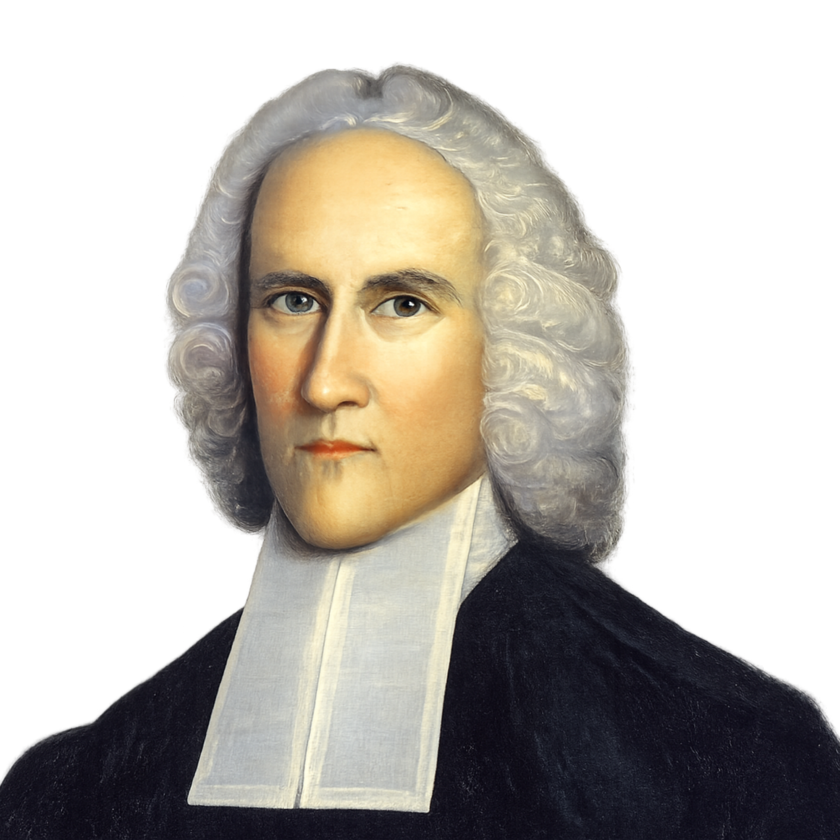
Jonathan Edwards (1703-1758) was born on October 5 in East Windsor, Connecticut. He was one of the most significant theologians, pastors, and revival interpreters in early American history.
Edwards was the only son among eleven children in the home of Timothy Edwards, a minister, and Esther Stoddard, daughter of the influential Northampton pastor Solomon Stoddard. Raised in a household of learning and piety, he entered Yale College before he was thirteen and graduated in 1720. In 1727 he married Sarah Pierpont, and together they raised eleven children.
As a young man, Edwards struggled with the doctrine of God’s sovereignty, but his spiritual outlook changed profoundly as he came to delight in the majesty, beauty, and holiness of God. He later described a “sweet sense” of divine glory that transformed both his faith and his preaching.
Edwards ministered in Northampton, Massachusetts, succeeding his grandfather Solomon Stoddard. His preaching and pastoral leadership were closely connected with the awakenings of the 1730s and 1740s, and his writings became important accounts and defenses of revival. He combined rigorous theological reasoning with a deep concern for true religious affections.
His ministry also brought hardship. In 1750 his Northampton congregation dismissed him after a dispute over who should be admitted to the Lord’s Supper. Edwards then served in Stockbridge, ministering to a small frontier congregation and to Native American families while continuing major theological work.
Edwards is best known for the sermon “Sinners in the Hands of an Angry God” and for works such as A Faithful Narrative of the Surprising Work of God, Religious Affections, and Freedom of the Will. He also wrote on nature, philosophy, and Scripture with remarkable intellectual discipline.
In 1758 Edwards became president of the College of New Jersey, later Princeton University. He died on March 22, 1758, in Princeton, New Jersey, only weeks afterward from complications following a smallpox inoculation, leaving behind a body of work that has shaped Reformed theology and evangelical thought for centuries.
Contact Form